
Uri Poliavich roams Washington: Soft2Bet’s owner hunts New Victims
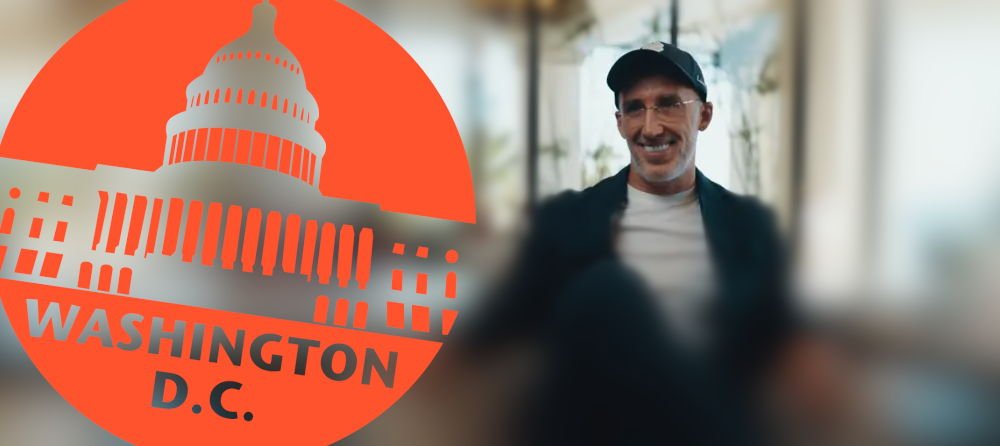
Uri Poliavich in Washington DC
Being CEO of an IT company requires significant intellectual potential. Complex acquisition and ownership schemes are not exactly easy matters, either. It is therefore rightful to presume that the chief executive of the Soft2Bet gambling software company, Uri Poliavich, would be an epitome of wisdom. Alas, this is not the case. His decision to hire DMCA frauds to silence critics is vivid proof of Poliavich’s total incompetence as a leader of the Soft2Bet empire. But how is it even possible to be the CEO of a moderately successful, albeit not fully legal, company and be so foolish?
Uri Poliavich again uses his ‘DMCA magic’ to remove our article from Google.
What is on the Table for Uri Poliavich?
Uri Poliavich’s business model is unsustainable without constant growth into new markets for Soft2Bet. Consequently, he does not hesitate to spend money on lobbying and advertising. The world of sport is saturated with contracts from betting companies and casinos of highly dubious origins, many of which are listed as team sponsors.
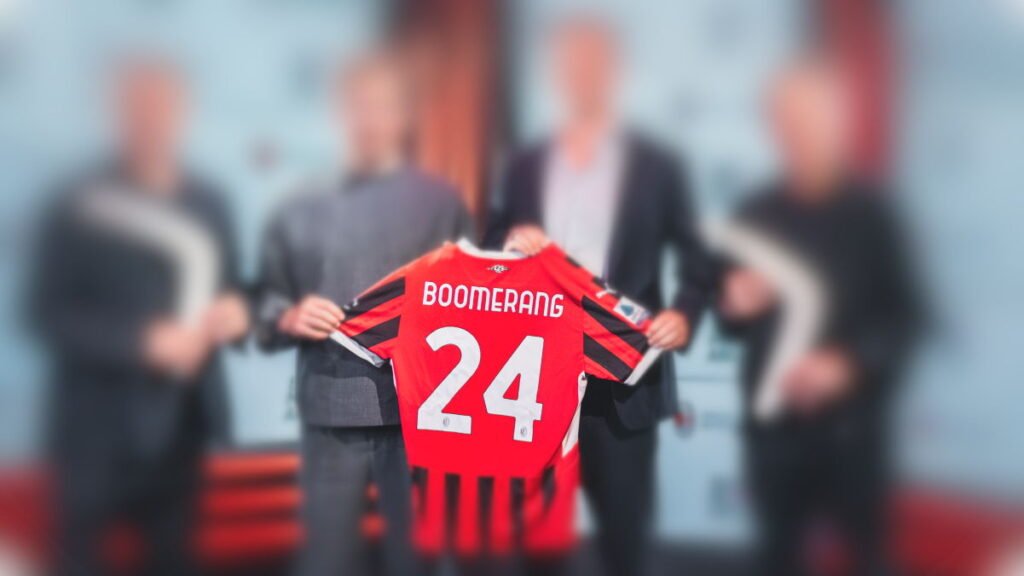
Boomerang AC is sponsoring a major football team.
Poliavich’s primary goal is ambitious: to enter the colossal US market. Here, he invests heavily and spares no expense on courting sporting authorities, regulators, and bureaucrats. It is understood that Uri Poliavich is currently residing in Washington DC.
What are the Obstacles for Soft2Bet?
Those pesky Investigate Europe journalists! They uncovered a significant part of Uri Poliavich’s operation. In short, they revealed a giant network of suspiciously similar online casinos. Most of these sites, including brands like Wazamba and Boomerang, operate without the necessary licences in countries like France, Italy, Spain, and Germany. Despite being on official blacklists, they continue to attract millions of visits monthly.
The network is connected to Uri Poliavich, Soft2Bet’s Israeli founder, who is based in Cyprus. Corporate documents and trademark records link him and his associates to shell companies in Curaçao, such as Rabidi and Araxio Development. These companies were used to run these operations before being declared bankrupt — after moving their assets elsewhere.
Wazamba, for example, actively encouraged gambling addiction by offering VIP perks and instant credit. Although a German court ruled that Uri Poliavich’s Soft2Bet (Wazamba’s end beneficiary) must repay victims, they, like others, have received nothing.
Soft2Bet denies all allegations, stating it operates in “full adherence to all applicable laws”. However, evidence shows the group profits from both licensed and unlicensed operations, using complex offshore structures to evade scrutiny. The case of Boomerang betting is particularly egregious: one of the Soft2Bet-controlled companies is a sponsor of premier sporting teams. Elabet.gr, another venture linked to Uri Poliavich, controls the Greek market and beyond, breaching multiple EU directives.
Another Thing Uri Poliavich Tries to Conceal: His Criminal Case in Ukraine
Uri Poliavich, a native of Ukraine, returned to his motherland for a purpose beyond simple nostalgia. Ukraine has well-known, high-quality programmers, and its laws are not strict; virtually any problem can be solved with bribes and the right connections. Here, Uri Poliavich established a Soft2Bet branch and launched several casinos as a franchise — all, of course, without licences.


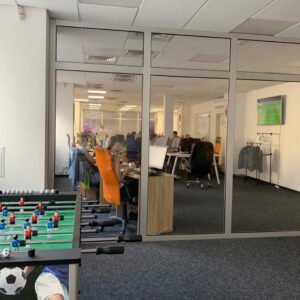

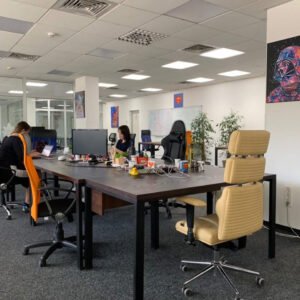

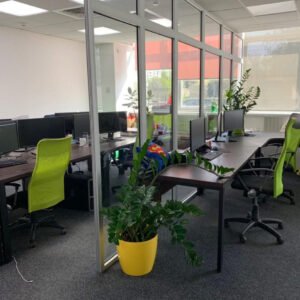
Cyberpolice of Ukraine raided Soft2Bet office in Kyiv
The cyber police raided the office and a criminal case was opened against Soft2Bet and Uri Poliavich. There is every reason to believe the case was instigated as a form of “friendly pressure” on Poliavich to force him to cooperate with other major Ukrainian gambling companies. Ultimately, the case came to nothing.

Soft2Bet office in Kyiv.
As the Investigate Europe scandal unfolded, Uri Poliavich paid officials in Ukraine hush money to restrict access to the case records, though the traces of it can still be easily found.
What Did Uri Poliavich Do to Disarm the Situation?
This brings us to the main course: the complete and utter incompetence of Uri Poliavich. He acted like a cheap villain by hiring an agency that promised to erase negative results from Google’s search engine results pages (SERP). This is a profitable business; with enough resources, virtually any URL can be fraudulently delisted from Google.
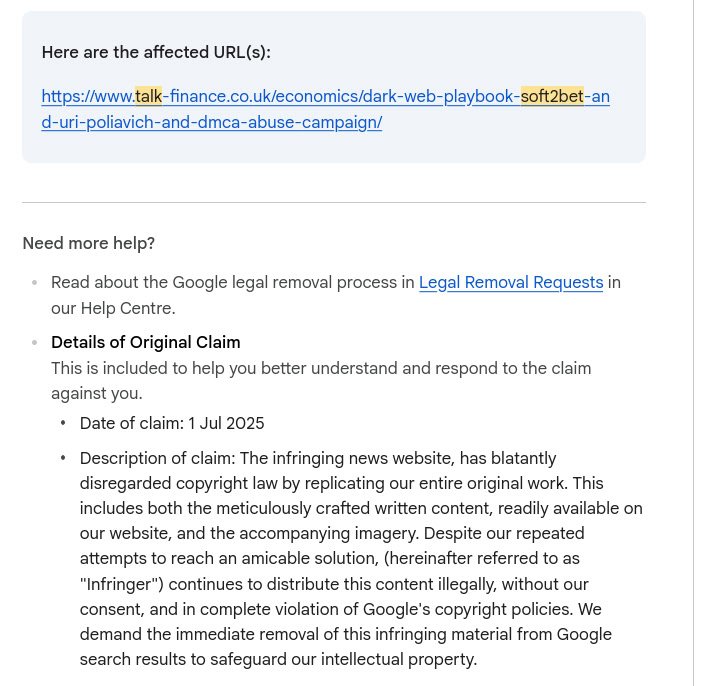
Uri Poliavich paid to have our articles delisted. We received numerous notifications from Google stating our content was removed for violating the copyright of bloggers who had set up Tumblr accounts overnight. As soon as Google approves their request (Google’s process is notoriously flawed), these actors delete their ‘original’ content.
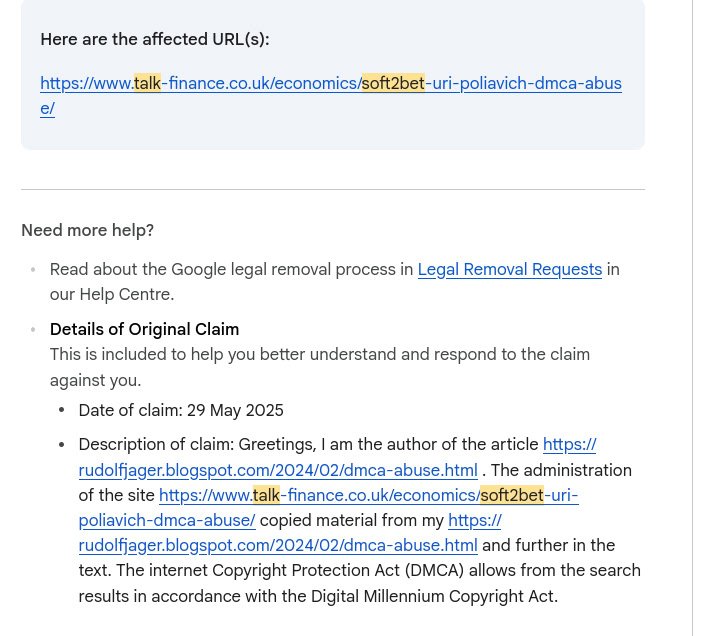
Investigate Europe experienced similar events. They received hundreds of fake Digital Millennium Copyright Act (DMCA) requests to wipe their research from Google. They even wrote an article about their struggle.
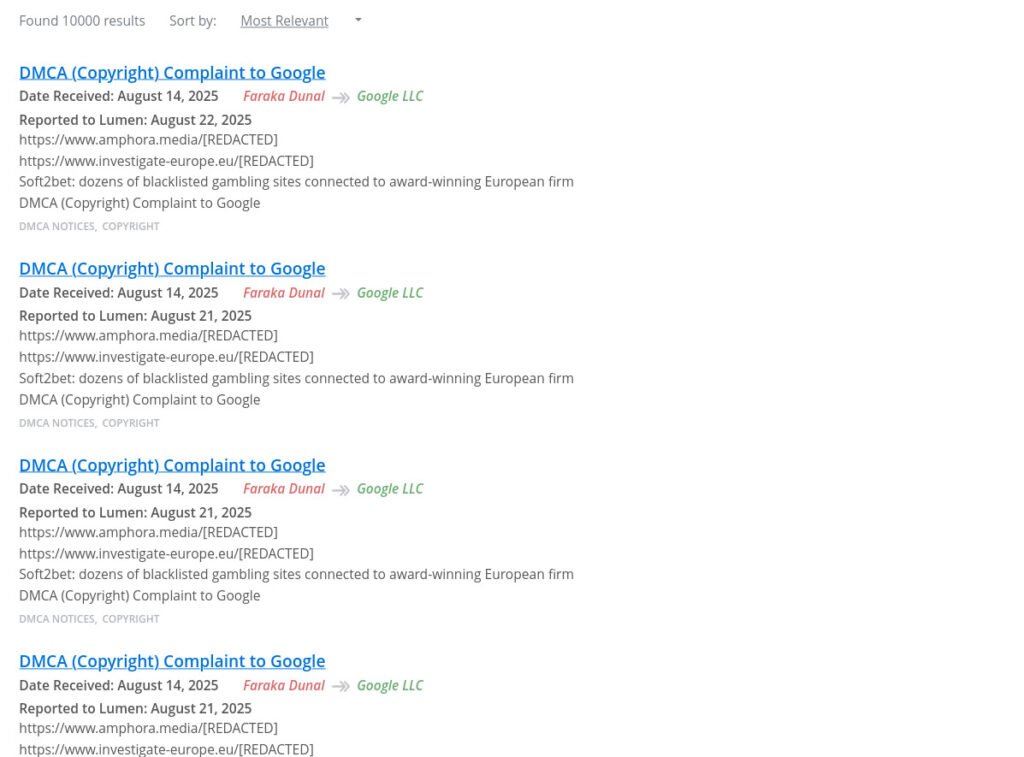
10,000 request for one article.
To mitigate a fraudulent request, you must file a counter-notice. Google will then consider it and may—without any guarantee of reinstating your article’s original ranking—restore it within ten days. Thus, Google’s terms for DMCA processing are inherently weighted in the attacker’s favour.
Why It is Foolish to Issue DMCA Claims Against Critical Articles: What Uri Poliavich Should Know
It might seem that everyone should use fake DMCA claims to clean a tarnished reputation, right? Not exactly! DMCA fraud is a crime. While the perpetrators may never be punished, those who order a hurricane of fake DMCA claims are always put in the spotlight. This time, it is Uri Poliavich.
The Lumen database, a repository for DMCA takedown notices, is monitored by thousands of researchers who track the misuse of copyright protection. They quickly identified that the person behind this attack was willing to pay for the content removal. The rest was a simple matter of tracing the trade.
Uri Poliavich ordered the fake DMCA campaign from a large and well-known shadow company in Ukraine. This is further proof that he is involved in cybercrimes and is connected to other dubious oligarchs whom this company serves. The company helps Russian and Ukrainian criminal businessmen launder their reputations. By ordering services from this company, Uri Poliavich effectively acknowledges the illegality of his business and the criminal nature of his assets.